In a world where we seem to have all the answers at our fingertips, are we unintentionally failing to understand? Technology has brought about numerous opportunities and pathways to obtain answers to our questions. However, should simply getting an answer be the end goal or should there be an end goal at all? Through the introduction, and first two chapters of W. Berger’s “A More Beautiful Question,” he discusses our innate nature to question and problem solve, and how it seems to almost fade as we age. He questions how we can teach questioning and inspire this need for change. Essentially, can we rekindle our questioning spark (Berger, 2014)?
Video 1: How many questions do children ask in a day? This video demonstrates Berger’s claim that young children are naturally curious and highly inquisitive, reinforcing the idea that questioning declines as students grow older.
Children spend a significant amount of time questioning things to simply gain understanding. In fact, four years old is our questioning peak (Berger, 2014). So why do we become more complacent over time? Are we fulfilled with the answers we have? Are we losing the ability to ponder deeply? Or perhaps we are underestimating our own ability to answer our own questions. Questioning enables innovation, problem solving, and brings about change (Berger, 2014). We are capable of bringing about such change if we know how to question.
Berger covers three major steps to simplify questioning: Why → What if → How (Berger, 2014). Stopping at why is stunting our growth in its tracks. “If you never do anything about a problem you’re not questioning, you’re complaining” (Berger, 2014). For some this could be because there are experts around whom seem to have (or think they have) all the answers. Berger argues that “what ifs” are not always welcomed in “what is” spaces. This calls into question our education system – are teachers the experts that have all the answers so students are failing to ask? If so, how can we ensure we are teaching students to ask beautiful questions? Beautiful questions are ambitious, actionable questions that can begin to shift the way we think and perceive something and can be used as a catalyst to bring about change (Berger, 2014). He states that questioning + action = innovation, and inversely questioning – action = philosophy. As an educator, my goal is to push my students towards innovation, in turn teaching them to question is the first step. This connects closely to my favorite third-grade lesson: “It is okay to make mistakes, but it is not okay to not try.” This lesson encourages students to take academic risks and view mistakes as learning opportunities, which reflects what Berger describes as the importance of “failing forward” in the questioning process.
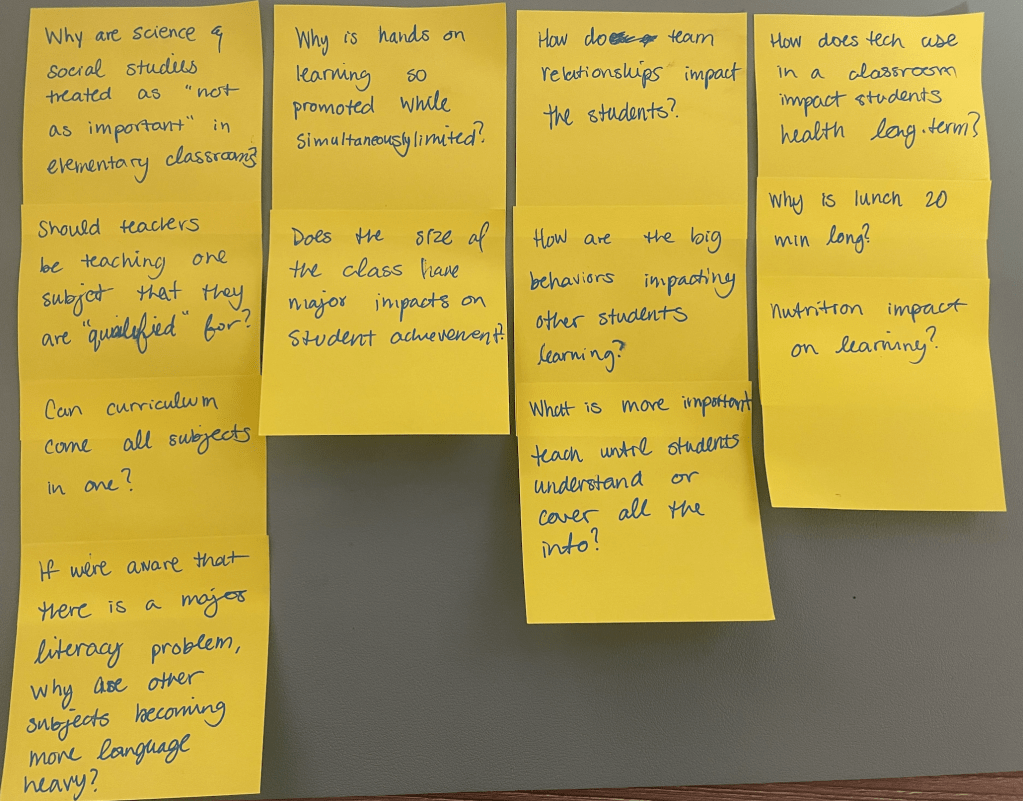
I was asked to complete a quickfire exercise that encapsulates this idea. Having us question starting with just the “why.” Set a timer for five minutes, and write all the questions (related to your practice) that come to mind. Being asked to question in that way was a bit intimidating and difficult to not over think, however, below are the questions I was able to generate.
Figure 1: Development of quickfire questions from initial responses (top left) to final reflection (bottom right).
Some questions related to others while some came out of left field. I also found it difficult to sustain the questioning process mentally over time. As soon as I had a question written I wanted to start thinking about the next step, searching for answers, the what if.
After the why comes the what if. Moving from asking to action. This is where imagination takes over – where the seeds of innovation are planted (Berger, 2014). What if is finding the space to connect interesting ideas in unusual ways involving both connections and questions. Berger coined this as “connective inquiry.” He then states that a questioner’s ability to conform to their ideas and make them real is what sets them apart and leads into the final critical stage of questioning: the how. This final stage is where we work to figure out “how do I actually get this done?” It is driven by practical questions to lead to an answer. However, each answer brings a fresh wave of questions, which lead to mine: should there be an end goal? If we want to impart on our students the ability to ask beautiful questions I believe the first step is to be a questioner ourselves. As we continue to read, I look forward to learning how Berger suggests we do that. This reinforces my belief that cultivating a culture of questioning in the classroom must be intentional, modeled, and continuously supported.
References
Berger, W. (2014). A more beautiful question: The power of inquiry to spark breakthrough ideas. Bloomsbury.
Dyslexia impacts much more than reading time for many students. Students with dyslexia can understand grade-level ideas but struggle to access written materials because decoding is so demanding and stressful. This becomes an ill-structured classroom problem because there is no single fix. Students encounter text in every subject in various ways, and success depends on factors like classroom routines, available tools, and whether students feel comfortable using support in front of peers.
Research supports the use of assistive technology to reduce barriers to text-based learning. In a five-year follow-up study of dyslexic students’ experiences with assistive technology, Almgren Bäck and colleagues (2024) found that tools like audiobooks and text-to-speech were consistently beneficial for accessing content over time. The study also highlighted that continued success depends on contextual factors in school (such as consistent support and expectations) and students’ emotional comfort using the technology in real classroom settings. Making this technology available to the whole class can help it feel less like a crutch and more like a tool.
One technology that can address this need is Speechify, a text-to-speech platform that allows students to scan printed text and listen to it read aloud. This is particularly valuable in non-reading-centered contexts, such as math assessments, where students may understand the math but struggle to read directions or word problems. A unique affordance of Speechify is its flexible navigation: students can pause, replay, and jump to specific parts of the text, supporting independence. A constraint is that scanned text can sometimes be misread or read out of order when layouts are crowded, which may confuse students who have difficulty identifying errors.
For Speechify to be successful, classrooms need clear routines for scanning and a shared understanding that listening counts as learning.
Screencast demonstration
References
Almgren Bäck, G., Lindeblad, E., Elmqvist, C., & Svensson, I. (2024). Dyslexic students’ experiences in using assistive technology to support written language skills: A five-year follow-up. Disability and Rehabilitation: Assistive Technology, 19(4), 1217–1227.https://doi.org/10.1080/17483107.2022.2161647
This week was honestly a mix of frustration and small wins. One of my biggest “wins” was simply figuring out where the sounds were in Scratch. That felt like a tiny thing, but it took way longer than I expected and felt like progress once I got it.
I spent a lot of time trying to make something in Python using Replit, but I couldn’t get to a point where I had something I actually wanted to share. Eventually, I switched to Scratch so I could at least complete the assignment. Even then, I’m not totally satisfied with what I made, but I do feel more comfortable navigating it now, and I’m excited to keep playing around with both platforms.
A big obstacle for me was the type of support available. A lot of the Python help resources were very text-heavy, which is not how I learn best. Scratch had more visuals and screenshots, which made a big difference. I also used YouTube and ChatGPT. YouTube helped, but I needed more time to explore on my own.
Video 1: Watching this walkthrough helped me learn through visuals, which worked better for me than reading directions.
ChatGPT was tricky because it kept giving me code when I really just wanted help thinking through the problem. That’s something I’m learning how to manage better.
Overall, this reminded me how important it is to provide multiple ways for students to learn. Not everyone will benefit from the same type of resource, and sometimes just having time to explore and struggle a bit is part of the process.
Learning is a living process that grows through connection and purpose. It begins in community, is sparked by curiosity, strengthened through exploration, deepened through reflection, and sustained by the people, tools, and world in which we live. Learning takes hold in what we already know and who we are, then stretches beyond those roots as we engage with others and move toward meaningful goals. It is not passive. Learning is active, living, and continuously growing.
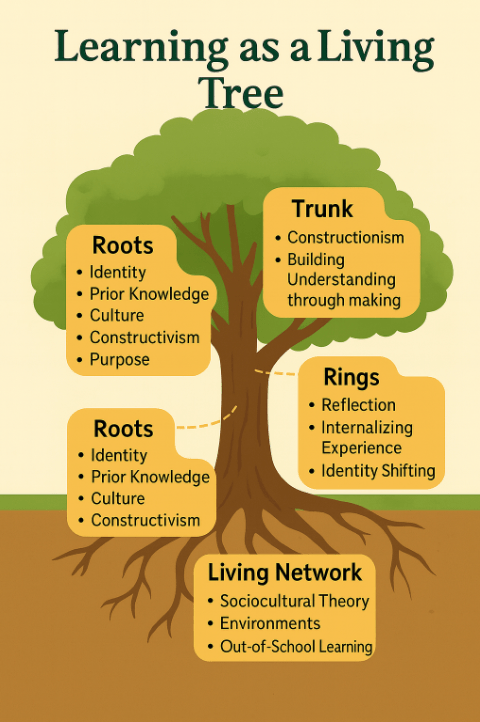
Figure 1. Learning as a Living Tree: A visual representation of my Theory of Learning. Created by Alexis Flanders using ChatGPT.
I understand learning as a developmental process rooted in meaningful experience and nurtured through relationships with others. Our learning is like a tree, grounded in prior knowledge and identity, shaped by the environment and those around us, and strengthened through purposeful engagement. A tree grows from a seed, not in isolation. Its growth depends on the soil that surrounds it, the climate, the supports or challenges it faces, and the network of life that interacts with it. In the same way, learning develops through active participation in the social, cultural, and intellectual worlds that surround us (Vygotsky, 1979; Lave & Wenger, 1991). Knowledge is not something that can simply be spoken into a learner. It is constructed, tested, revised, and extended with others through lived experience (Ackerman, 2001).
Roots
The roots of a tree firmly ground it and supply the nutrients that allow it to grow. In learning, roots represent prior knowledge, our own personal identities, and the motivations that give learning meaning. New understanding takes hold by connecting to what a learner already knows and values. Without our roots, information may be memorized temporarily, but it rarely becomes true, valuable understanding.
Learning deepens when it has purpose. Purpose fuels the will to persist and improve. The things I have learned most fully in my life have been those tied to meaningful goals. When I trained for a half marathon, the learning involved far more than accumulating miles. It required coordinating nutrition, pacing, strength work, and reflecting on what was and was not working for my body. That process drew from what I already knew about persistence in athletic training, but it also required new knowledge, trial and error, and constant reflection about how to adjust and be better. The learning was anchored in who I was, the goals I was working towards, and my desire to grow. Like roots taking hold in soil, purpose gave that learning a reason to deepen.
A tree cannot grow without the right environment. The soil quality, climate conditions, and surrounding organisms influence how well the roots absorb nutrients and whether growth is supported or restricted. Similarly, learning is inseparable from the social and cultural environments in which it takes place (Vygotsky, 1979). The community, language, tools, values, and social norms of a learning space shape what is available to learn, how learning is expressed, and what forms of knowledge are recognized.
The sociocultural perspective views learning as a process of becoming through participation in cultural practices (Lave & Wenger, 1991). People learn by engaging with those around them, using the tools and symbols of their community, and gradually moving from peripheral observation to more active participation. Within these shared practices, learners actively construct understanding by connecting new experiences to what they already know, reflecting a constructivist view of learning as developing meaning rather than passive absorption (Ackerman, 2001). What a person knows and who they are becoming cannot be separated from the environments in which they learn. Constructionism further emphasizes that this process is strengthened when learners create and explore ideas through hands-on activity, using the tools and practices of their community to make thinking visible (Harel & Papert, 1991). Identity and learning develop together.
This anchoring of new understanding to what someone already knows further reflects constructivist and constructionist perspectives. Together, these theories emphasize that learning grows through active meaning making and purposeful creation rather than passive reception (Ackerman, 2001; Harel & Papert, 1991).
Not all learners experience alignment between their identities and the environments where they learn. When the soil does not reflect or value a learner’s cultural background, language, or ways of knowing, the learner is not nourished in the same way. Recognizing the role of culture in learning does not prescribe a particular teaching action, but it acknowledges that the environment deeply matters. The soil that surrounds a learner supports or limits the root’s ability to take hold and grow.
A young tree growing on the edge of a clearing leans toward the sunlight. It adapts to the conditions it was given. The trees deeper in the forest grow straighter, supported by shade, shelter, and rich soil. Each is learning how to grow, but not under the same conditions.
Trunk
The trunk of a tree represents the development of structure, strength, and overall coherence. In learning, this development occurs through doing something with knowledge. Constructionism emphasizes that learning becomes most powerful when people actively create, experiment, and make meaning with real tools and materials (Ackerman, 2001). Through making, ideas take form, becoming testable and adaptable. Understanding moves from abstract to tangible.
Harel and Papert (1991) expand on this by recognizing that learning grows through the interplay of constructing ideas in the mind and constructing something in the world, allowing each to strengthen the other.
Constructionist learning is evident when learners are able to design, build, write, perform, or create something that expresses and tests their thinking. The process of making becomes the process of understanding.
Video 1. Video illustration of constructivist and constructionist perspectives, supporting the idea that learners build understanding through active creation.
This perspective reflects my own experiences. Whether learning to use my bow with my family or preparing for a race, learning developed through practice with feedback, making adjustments, and applying what I was discovering. It was not a lecture or a list of steps that built my understanding. It was the act of doing.
Branches
Branches stretch a tree upward and outward, reaching for the light and for new possibilities. In learning, branches represent the ways we grow through observation, imitation, and social interaction. Much of what we come to know is influenced by the people we watch, observe, and interact with.
Video 2. Animation of social learning theory illustrating how learning develops through observing and interacting with others.
Social learning highlights that understanding often begins by noticing how others think or act, holding on to those ideas, trying them out for ourselves, and refining them over time (Bandura, 1971; Cherry, 2025).
Throughout my life, I have learned a great deal by observing the practices of others in both my personal and professional worlds. When I became a teacher, I watched colleagues greet students, the ways they structured their days, and how they communicated with families. I noticed what felt authentic to me and what did not. Listening to professors talk through their thinking and share their own classroom experiences allowed me to picture new possibilities for my own development. Even social media has become a space for that, influencing my learning. Observing different creators, educators, coaches, and all of these digital experts who provide ideas and strategies gives me things I can try, reflect on, and reshape into something that fits who I am.
Growing through observation is not always positive, though. The same visibility that inspires growth can also influence habits, beliefs, or behaviors that limit us. I have learned ineffective practices simply because they were common or praised. There have been moments when I caught myself speaking in a way that did not feel like my own voice, only to realize I had absorbed the language of others without questioning its impact. I see students experience the same thing. You become a product of your environment, and that’s not always positive. Observation is powerful, but not always beneficial. It takes awareness to notice what we are internalizing and whether it supports the kind of learner or person we are becoming.
A moment that stands out is when I first began sharing classroom ideas with coworkers. Early in my career, I often mirrored different management styles because that was what I had seen modeled as successful. Over time, I realized the classroom environment I wanted relied on warmth, relationships, and shared ownership. I could not simply imitate what I had observed. I had to notice, evaluate, adapt, and then integrate the ideas that aligned with who I was and who I hoped to become. That is where learning expanded. Not just a copy and paste, but reflection and application.
Observation creates opportunities, but reflection transforms them. Branches grow toward the sun that feels most sustaining. In the same way, learners expand in directions they find meaningful through support and inspiration.
Rings
The rings within a tree tell the story of its life. Each ring marks a season of growth shaped by the conditions of that time. Some years produce wide rings, full of nourishment and expansion. Others are thinner and harder earned. Reflection works in a similar way. It helps us notice what we’ve learned and how it’s shaped us, revealing how our learning has grown over time.
Some of the most important learning in my life has come from looking back. Reflection gives meaning to experience and reveals how one season of learning prepares us for the next. The process of training for my half marathon and learning to hunt did not feel profound in single moments. The understanding came later through looking back at the choices I had made, the successes I experienced, the discomfort I pushed through, and the growth that followed. Reflection helped turn isolated experiences into a connected story of who I was becoming.
In the classroom, I often observed this same process. A student who struggled early in the year would look back months later and suddenly recognize the progress they had made. They could see how their thinking expanded and how they were able to handle challenges differently. Their practice shaped confidence. The moment of noticing became another ring of growth, marking not only what they had learned, but how learning had changed them.
These moments of realization also reflect sociocultural and constructivist perspectives. reflection allows learners to internalize shared experiences and recognize their understanding, turning social participation into personal meaning (Vygotsky, 1979). Constructivist views similarly recognize reflection as the process through which new experiences reshape existing knowledge frameworks (Ackerman, 2001). In this way, reflection does not sit outside the learning process. It is one of the ways new rings form.
Reflection is what helps learning settle into the trunk of who we are. Without it, experiences remain scattered like fallen leaves. With it, they become the rings, strengthening our sense of self and expanding our understanding of the world.
The Living Network
A single tree is never truly alone. Even trees that appear separate above ground are often connected through shared soil and nutrients in underground networks. Learning also exists within systems that extend beyond human interactions. The natural world, animals, technology, and environments all influence how we learn and who we become.
Some of my most memorable learning has come from interacting with the natural world. Practicing archery outdoors, observing animal behavior, and learning how to track movements in the woods required attention to the environment, the wind, and the sounds. The learning came from direct interaction, not from another person explaining it. Instead, learning developed through repeated observation paired with feedback from the environment and adjustment over time. The woods themselves taught me to be still, patient, and aware. This process embodies social learning theory, which emphasizes learning through observation and interaction with your environment rather than solely through direct instruction (Bandura, 1977). Learning in this sense was relational, but the relationship extended beyond human interaction.
Digital tools also expand learning. Technology allows us to join communities beyond our physical spaces, explore interests, and gain access to knowledge that would otherwise be out of reach. Learners can develop understanding through interaction with tools that extend what they can see and do. Through digital spaces, learners also engage in vicarious learning by observing others and modeling strategies while adapting behaviors based on shared experiences.
Research on out-of-school learning illustrates the same idea. Learning happens in museums, community centers, outdoors, in homes, and in digital environments where people get to explore interests, engage in cultural practices, and make meaning with others (Vadeboncoeur, 2006). These spaces broaden the network that supports growth by offering experiential learning that is flexible and self-directed while being connected to the real world. This supports social learning by allowing learners to observe, experiment, and reflect within authentic environments.
These influences also echo social learning theory, where learning develops through observing, interacting with, and responding to both human and non-human elements within the environment through reciprocal relationships between behavior, personal factors, and environmental conditions (Bandura, 1977; 1986). Whether watching the behavior of animals, responding to environmental cues, or engaging with digital communities, learners draw from the networks around them to construct understanding. Learning remains relational even when the relationship extends beyond direct human contact.
Closing
Learning is a living process, like a tree. It is rooted in who we are and where we come from. It grows through experiences, connections, and our ability to reflect and reach outward into new possibilities while drawing strength from what has come before. Over time, learning becomes part of our identity, shaping how we see the world and how we move through it.
Taken together, these ideas show learning as an interconnected system rather than a single process. The Roots reflect constructivist and constructionist perspectives, grounding learning and prior knowledge, identity, and purposeful engagement (Ackerman, 2001; Harel and Papert, 1991). The trunk represents the growth that develops through active making and doing. The branches reflect social learning, expanding understanding through observation and modeling while participating with others (Bandura, 1971). The Rings highlight reflection as the force that deepens meaning and connects experiences over time (Vygotsky, 1979). Even the living network surrounding the tree illustrates how environments and communities continually influence growth. Together, these perspectives form a theory of learning that is dynamic and grounded in experience.
These ideas align with research on out of school learning which captures the idea that a learner’s growth spans across settings, cultures, relationships, skill levels, and life experiences rather than being confined to formal environments (Resnick, 1987).
The most meaningful learning is not quick nor passive. It is lived, appreciated, shared, and carried forward. It leaves rings within us, marking who we were, who we are, and who we are becoming.
References
Ackerman, E. (2001). Piaget’s constructivism, Papert’s constructionism: What’s the difference. Future of Learning Group Publication, 5(3), 1–11.
Bandura, A. (1971). Social learning theory (Vol. 1). General Learning Press.
Cherry, K. (2025, March). Albert Bandura’s biography (1925–2021). Verywell Mind.
Harel, I. E., & Papert, S. E. (1991). Situating constructionism. In I. E. Harel & S. E. Papert (Eds.), Constructionism (pp. 1–11). Ablex Publishing.
Lave, J., & Wenger, E. (1991). Situated learning: Legitimate peripheral participation. Cambridge University Press.
Resnick, L. B. (1987). Learning in school and out. Educational Researcher, 16(9), 13–20.
Vadeboncoeur, J. A. (2006). Engaging young people: Learning in informal contexts. Research in Education, 30(1), 239–278.Vygotsky, L. S. (1979). Consciousness as a problem in the psychology of behavior. Russian Social Science Review, 20(4), 47–79.
For my final project, I designed a third-grade social studies unit that weaves computational thinking into map skills and navigation. What began as a simple idea about teaching directions became something much bigger. It turned into a five-lesson sequence integrating decomposition, abstraction, algorithms, debugging, and digital creation.
At first glance, it looks like a social studies unit about maps. But underneath, it is computational thinking in action!
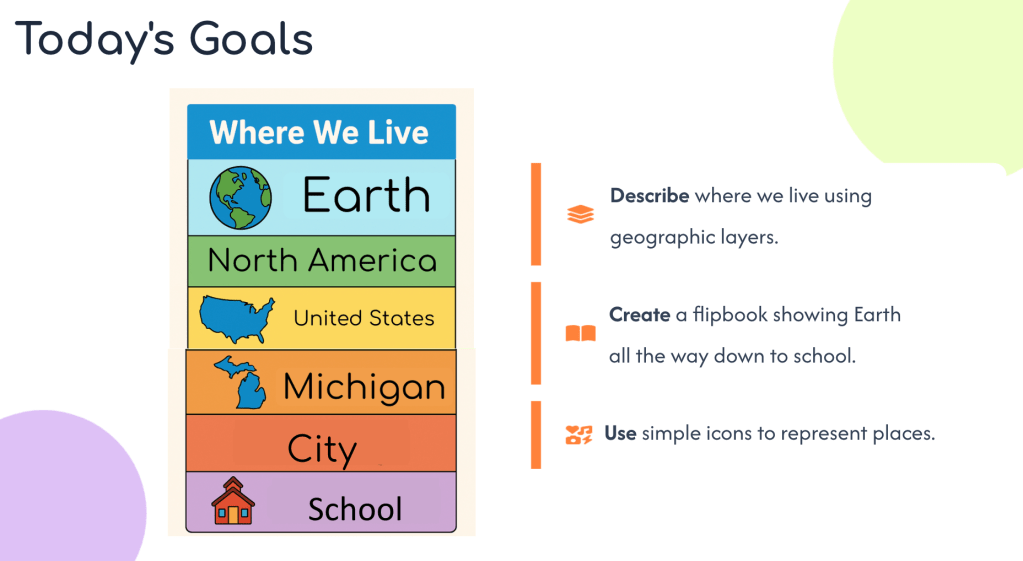
Students begin by identifying where they live in nested geographic layers: Earth → North America → Michigan → City → School (see supplemental materials, p. 1 Final Supplemental Materials). That layering alone introduces abstraction. We zoom in and zoom out, deciding what matters at each scale.
Figure 1. Students examine geographic layers to understand how abstraction works when we zoom in and out
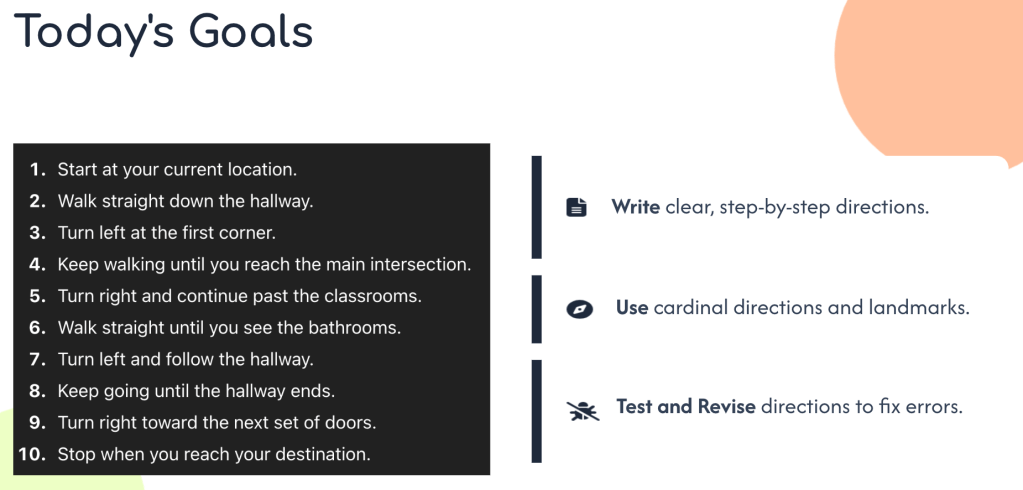
From there, students analyze and create school maps (p. 9 Final Supplemental Materials), write step-by-step navigation instructions using landmarks and cardinal directions (p. 13 Final Supplemental Materials), revise those directions after partner feedback (p. 23 Final Supplemental Materials), and eventually build digital mazes in MakeCode Arcade.
Figure 2. Students create precise step-by-step directions, practicing algorithmic thinking
What looks like map practice is actually:
Decomposition: Breaking navigation into manageable steps
Algorithms: Writing clear, ordered directions
Debugging: Testing directions with a partner and revising when they fail
Abstraction: Designing maps with only essential details
Automation: Turning clear instructions into repeatable digital behavior
The final “Design Your Own Navigation Challenge” pushes students to synthesize everything (p. 19–21 Final Supplemental Materials). They create a challenge, design a simplified map, write precise directions, test with a partner, revise, and then imagine a digital upgrade.
It’s playful, structured, real thinking!
About the MakeCode Component
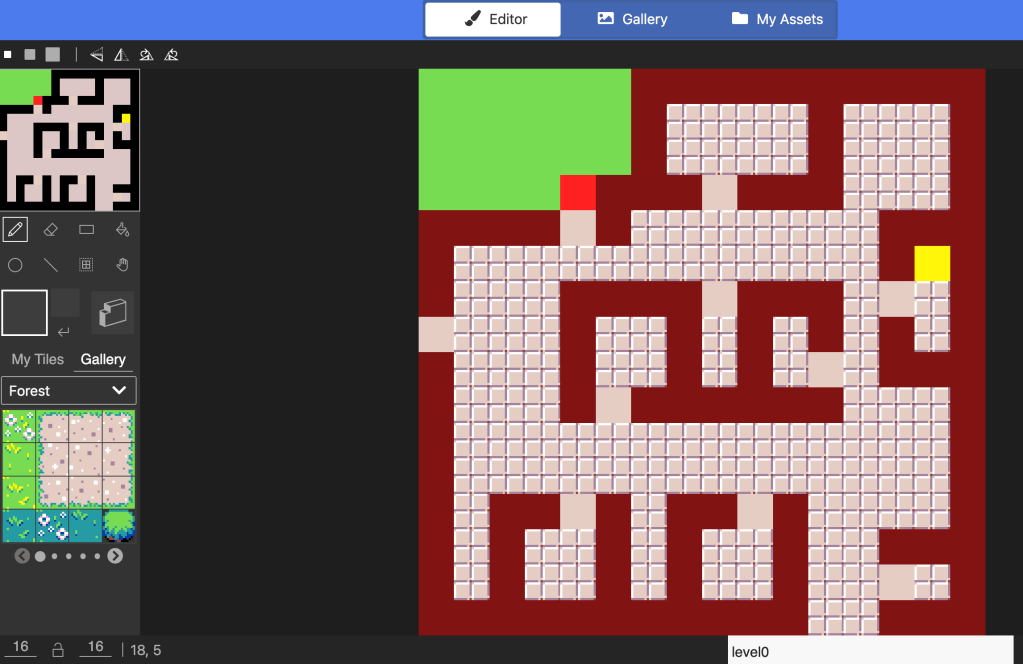
I intentionally kept the MakeCode portion simple. Click the map to test my example!
Figure 4. Students translate their written algorithms into a simple MakeCode maze, where precision becomes essential
It was actually harder to make it simple than to make it complex. I wanted this to feel realistic for third graders encountering block coding for the first time. The goal was not a flashy arcade game. The goal was clarity.
Students apply their written algorithms to a digital maze, where mistakes immediately surface. The computer does not “interpret.” It follows instructions exactly. That tension is where learning happens.
A New Tool I Tried
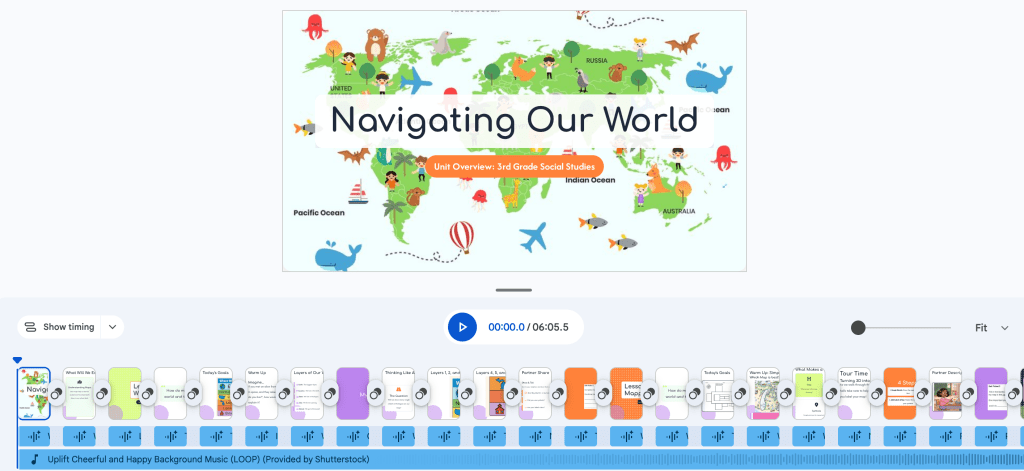
For this project, I experimented with something new: uploading my slides into Google Vids and using the AI voiceover feature. It generates narration that aligns with slide content, adds transitions, and even infers context (how cool)! The voiceover for this unit was entirely AI-generated from my slides.
Figure 5. Google Vids AI voiceover feature used to generate narration for the lesson slides
It was surprisingly natural.
This tool is currently blocked on my MSU account, so I tested it using my personal account. I wanted to include it because I think it’s a powerful option for teachers who need accessible, flexible presentation tools.
What This Project Changed for Me
Designing this unit made something obvious: computational thinking already lives in my classroom. I just did not always name it.
When students revise directions, they are debugging. When they simplify maps, they are abstracting. When they break a route into steps, they are decomposing.
My professor challenged me to make the computational thinking vocabulary more explicit with students. I agree. Third graders are capable of those words. Naming the thinking gives it weight.
This unit does not add computational thinking to social studies.
I used AI as a support tool while creating this unit. AI helped me check grammar, generate a few images, and create slides. All decisions about the content, structure, and final materials were made by me.
Automation felt straightforward at first. Systems follow rules. They remove repetitive work. They free up time and mental energy. Simple enough…or so I thought.
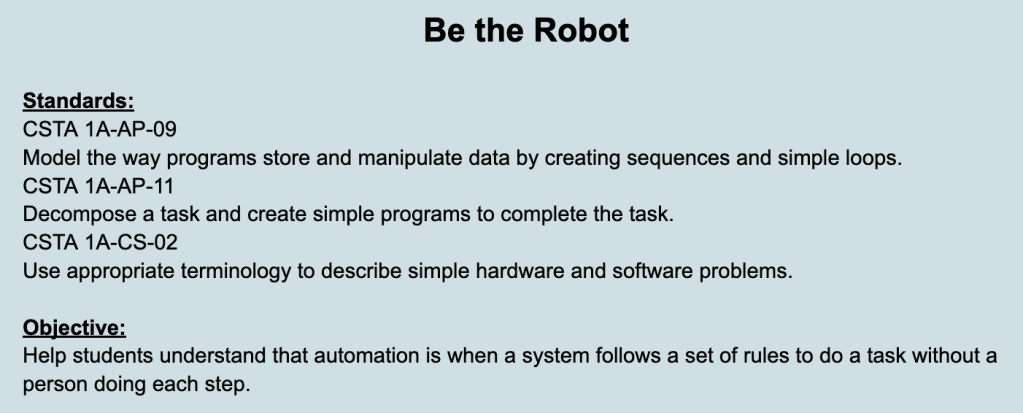
For my automation creation, I created an unplugged classroom activity where students act as robots. Partners give step-by-step instructions to complete a task. If the directions are unclear, the “robot” fails. If the steps are precise, the task works.
Figure 1. Unplugged “Be the Robot” activity designed to introduce automation through step-by-step programming
It connected beautifully to sequencing and debugging. Students would:
Break a task into small pieces.
Test their “program.”
Revise when something went wrong.
It felt natural. It mirrors how I already teach clear routines and procedures in my classroom.
And then I received feedback…
My professor pointed out that while the activity clearly connected to algorithms, it did not yet make the need for automation obvious enough. It showed how to follow instructions, but not necessarily why we automate in the first place.
That distinction mattered. Algorithms are about steps, while automation is about reducing repeated thinking. That subtle difference pushed my thinking further.
When I revisited my brainstormed examples of automation in my students’ lives, it became clearer:
Logging in with QR codes instead of typing credentials
Math programs adjusting difficulty automatically
Google Classroom surfacing commonly used links
Spell check correcting without teacher intervention
Classroom timers running routines
All of these systems remove the need to re-decide something over and over again. My unplugged activity captured the structure of instructions. What it almost captured was the relief automation brings when something becomes repeatable.
That feedback didn’t invalidate my lesson. It helped refine my understanding. Automation is not just following steps. It is designing systems so the steps no longer require new effort each time.
As an elementary teacher, I see this constantly. Routines become automatic. Transitions become automatic (hopefully). Classroom systems become automatic. And when they do, students have more energy to think deeply about content instead of logistics.
That realization felt bigger than the activity itself.
Automation is not flashy. It is the sneaky invisible efficiency.
And understanding that difference sharpened my thinking far more than simply completing the assignment ever could.
If there is one constant in this course, it’s this: MakeCode Arcade is my favorite part of every unit!
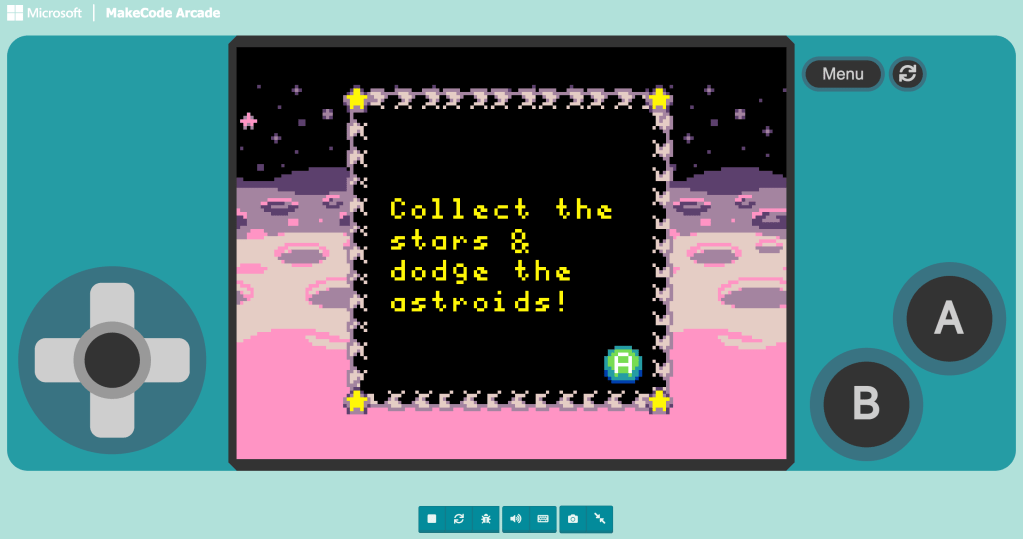
For this creation, I built a Jedi-themed game. The concept sounds simple. A character runs across space collecting stars and dodging asteroids. Stars add points. Asteroids subtract them. A countdown runs. The Star Wars–inspired theme plays in the background. Collect a star and the Jedi says something dramatic like, “Do or do not, there is no try.”
Simple. Except it wasn’t.
When “Simple” Breaks
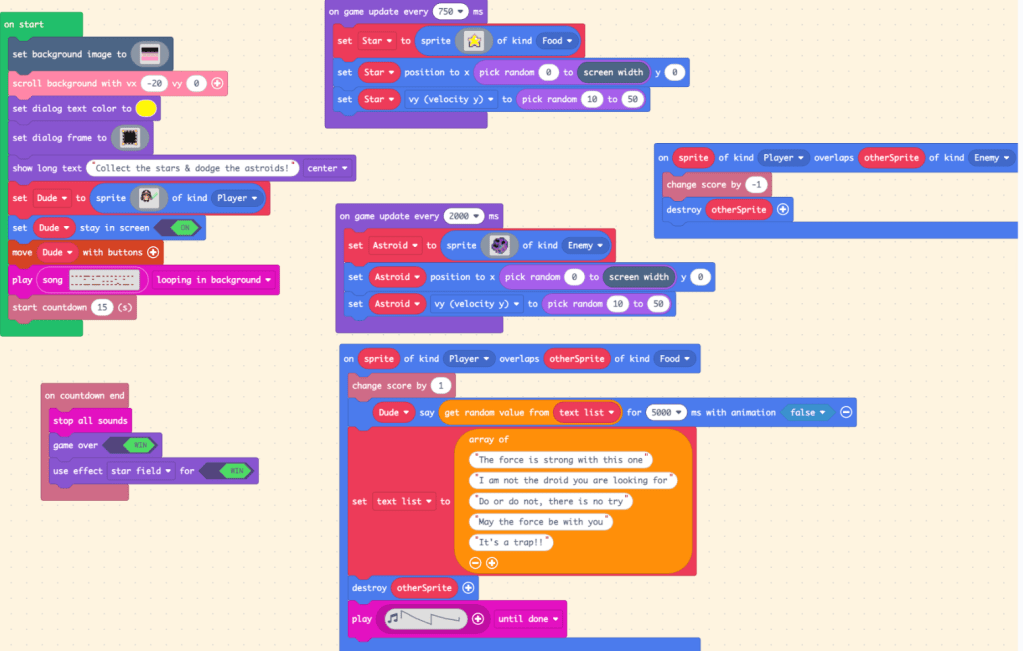
What looked straightforward on paper quickly turned into a debugging session. Stars were spawning in one place. My score was skyrocketing even though I was certain I had destroyed the sprite after awarding +1. Things were happening…just not the way I thought they should.
That was the moment computational thinking became real. I had to stop assuming and start observing. What was the code actually doing? Not what I intended and not what I pictured. What was it actually doing? That change in thinking matters.
Figure 1. Code structure for spawning stars, asteroids, and handling overlap events
Computational Thinking in Action
This project forced me to use multiple components of CT:
Decomposition: I broke the game into parts. Player movement. Star spawning. Asteroid spawning. Overlap logic. Scoring. Countdown.
Pattern recognition: I noticed that my star and asteroid logic followed a similar structure. Once I saw that pattern, I reused and adjusted instead of rebuilding from scratch.
Abstraction: Instead of writing separate dialogue blocks for each Jedi quote, I created a list of sayings and pulled from it randomly. One structure with multiple outputs.
Algorithmic thinking: I had to think step by step about what happens first, what triggers next, and what conditions change the outcome.
Even the music became part of the abstraction conversation. In earlier projects, I had used solfege, which was incredibly limiting. This time, I used the sheet music tool and built a looping background theme using structured notation. Instead of isolated tones, I was thinking in sequences and patterns.
That felt like I was leveling up.
What the Player Sees vs. What’s Actually Happening
From the outside, the game looks playful:
A Jedi hobbling across a planet in space
Raining stars and asteroids
Random quotes popping up
A dramatic looping theme song
Click to play my game:
Figure 2. Gameplay view of the Jedi star-collecting game in action
But underneath that is logic layered on logic. Every visual moment depends on conditions, timing, variables, and structure. When one tiny piece is off, the whole illusion cracks.
Why This Matters
What I appreciate most about MakeCode is that it forces thinking into the open. You cannot hide incomplete logic. The computer does exactly what you tell it to do. Debugging becomes less about frustration and more about investigation. What assumption did I make? What step did I overlook? What rule did I forget to define?
The hands-on process makes computational thinking tangible. Not theoretical. Not vocabulary. Not a worksheet definition. It’s thinking you can see.
And honestly? That’s the experience I want my students to have too!
Schools regularly point to learning theory as justification for instructional practices, but the way those theories are used in classrooms rarely reflects how learning actually occurs for students. The gap is not about teachers misunderstanding theory, but about schools attempting to layer multiple theories at once without creating the conditions that make any of them effective. What results is a system that looks theoretical on paper but functions as compliance in practice.
What Schools Think They’re Doing
Schools believe they are implementing behaviorism, cognitivism, and social learning to support growth. Attention getters are treated as classical conditioning, assumed to cue instant silence (McLeod, 2024). Write-ups are framed as operant conditioning, intended to change behavior through consequence (Cherry, 2024). Scripted curriculum is marketed as schema-building, connected to cognitivist ideas about sequencing knowledge so it encodes into memory (Putnam and Borko, 2000). Whole-group lessons are described as constructivist because students are “given” knowledge before applying it. Manipulatives are displayed as constructionism, even though most activities are teacher directed reproductions rather than student created models. Schools also reference Vygotsky’s Zone of Proximal Development to justify grouping and proximity support (Vygotsky, 1979), and they call group work collaboration, assuming it reflects social learning. The language is correct, but the implementation is shallow. These strategies gesture toward theory instead of embodying it.
What Actually Happens in Classrooms
In practice, these strategies break down quickly. Many students repeat the attention getter but keep talking, showing there is no conditioned behavioral shift. Write-ups become documentation rather than reinforcement because there is rarely a meaningful consequence attached. Scripted curriculum forces teachers to cover content rather than connect it, and they are blamed when students fail to meet benchmarks despite “following the program.” Whole-group instruction widens learning gaps in classrooms where readiness levels stretch across several grade levels. Manipulatives become compliance tools instead of thinking tools, used to produce the teacher’s predetermined answer. Group work is often one student doing the writing while the others stay passive. Real learning happens, but it happens around the system, not because of it.
The Assessment Mismatch
The biggest problem with assessment in school is that scores end up mattering more than the actual learning behind them. Students memorize information just long enough to retrieve it, but because it is only stored in short-term memory and never linked to prior knowledge, there is no real schema to connect it to. They are not building understanding but rehearsing. Cognitivism shows that learning sticks when encoding leads to meaningful retrieval (Putnam and Borko, 2000), but the pace of curriculum prevents students from ever getting there. In data meetings, the conversation is whether numbers moved, not whether thinking deepened. Students may never hear the meeting, but they feel its impact when instruction is rushed and curiosity is treated as a distraction. High-performing students learn their value lies in staying ahead, while struggling students learn they are permanently behind. Instruction becomes about surviving the pacing map instead of working within a child’s actual ZPD. The test becomes the finish line and the number becomes the identity, which is the opposite of what learning is supposed to be.
Where Real Learning Actually Happens
Real learning shows up when students can participate, observe, and make meaning in context. It appears when students learn from peers through modeling, which reflects observational learning (Bandura, 1971). It happens when one student becomes a more knowledgeable other for a classmate through natural apprenticeship instead of teacher assignment. It surfaces when students engage with their environment and the learning is situative rather than scripted. One example is when my class went outside and built arrays using wood chips, sticks, and leaves. The content was identical, but the change in environment transformed their thinking. Students were testing, revising, troubleshooting, and explaining. They were immersed in a community of practice rather than performing understanding for a worksheet. The motivation came from relevance and participation, not reinforcement charts.
The Big Claim
What school delivers most of the time is education, not learning. Education is passive, curriculum centered, and driven by extrinsic performance goals. Learning is active, curiosity driven, and rooted in intrinsic motivation. When instruction serves pacing rather than understanding, students perform knowledge instead of developing it. Curiosity becomes something to “fit in later” instead of something to build from. The most meaningful academic moments are often the ones that stray from the script, when student questions lead to investigation, connection making, and discovery. Those are the moments where students are not being educated but are becoming thinkers.
Reframing What School Could Be
If the real focus of school were learning instead of assessment, classrooms would function differently. Students would have agency in the questions being explored. Apprenticeship and peer modeling would be normalized rather than incidental. Scaffolding would be responsive instead of standardized. Classrooms would operate as communities of practice, where ideas are built, tested, and revised, not rehearsed for a score. Assessment could support learning if it measured participation, transfer, and growth within authentic activity, aligned with situated learning principles (Lave and Wenger, 1991). In a school built around learning, students would not perform understanding to prove mastery. They would interact with ideas until mastery becomes visible on its own.
References
Bandura, A. (1971). Social learning theory (Vol. 1). General Learning Press. Cherry, K. (2024, July 10). Operant conditioning in psychology: Why being rewarded or punished affects how you behave. Verywell Mind. McLeod, S. (2024, February 1). Classical conditioning: How it works with examples. Simple Psychology. Putnam, R. T., and Borko, H. (2000). What do new views of knowledge and thinking have to say about research on teacher learning? Educational Researcher, 29(1), 4 to 15. Vygotsky, L. S. (1979). Consciousness as a problem in the psychology of behavior. Russian Social Science Review, 20(4), 47 to 79. Lave, J., and Wenger, E. (1991). Situated learning: Legitimate peripheral participation. Cambridge University Press.
Unit 6 shifted my focus to automation, and it immediately felt relevant to students’ everyday lives.
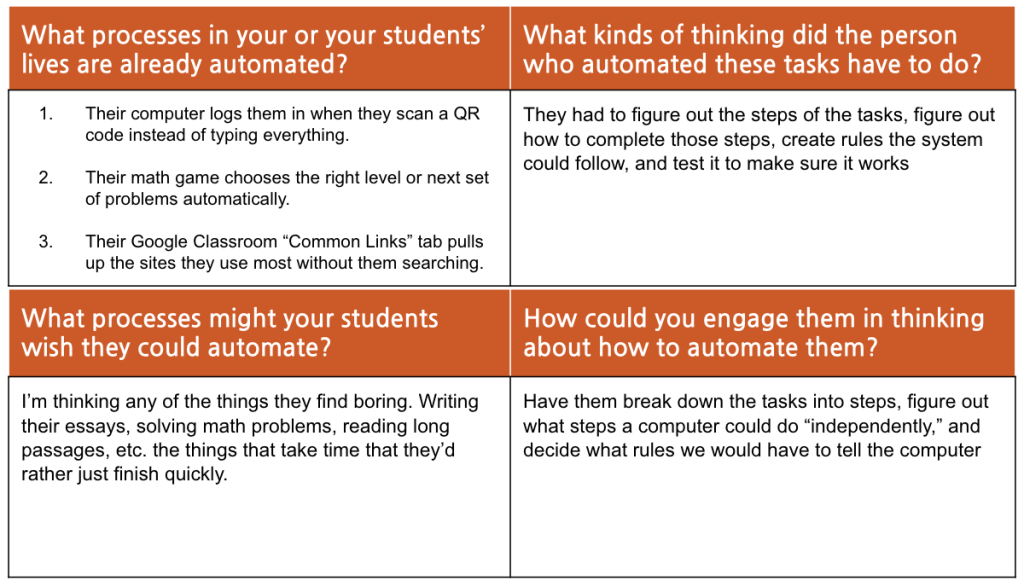
In my first activity, I brainstormed examples of automation my students already experience. Their computers log them in automatically when they scan a QR code. Math platforms adjust difficulty levels without a teacher intervening. Google Classroom surfaces commonly used links so students do not have to search for them.
Figure 1. Brainstorming examples of automation in students’ everyday lives
When we pause to name it, automation is everywhere.
What struck me most was the thinking required behind those systems. Someone had to break down the task into steps, determine rules the system could follow, anticipate edge cases, and test the process. Automation is not about replacing thinking. It is about doing the work up front.
When I asked myself what students might wish they could automate, the answers were predictable: writing essays, solving long math problems, and reading extended passages. The “boring” tasks that are time consuming.
That opens a fun classroom conversation. If you wanted a computer to write your essay for you, what steps would it need? What rules would you have to define? What decisions would it struggle to make? Breaking down those processes reveals the complexity students (and teachers) often underestimate.
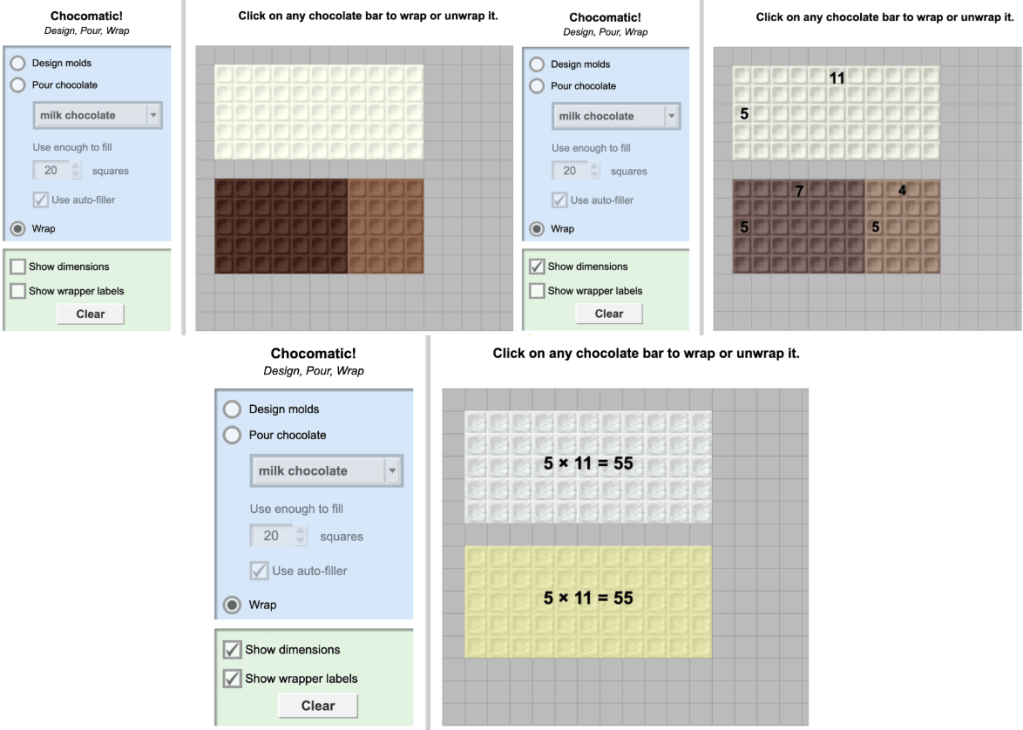
To bring automation into math instruction, I created a simulation lesson using the Chocomatic simulator fromExploreLearning’s Gizmos platform. Gizmos provides structured simulations with built-in lesson materials, but I designed my own activity plan around this tool to align specifically with my focus on arrays, decomposition, and the distributive property.
In the lesson, students build an array in the simulator, then decompose it into two smaller arrays and record the corresponding equations. They repeat the process in a second way and compare what changed and what stayed the same.
This activity highlights automation in a subtle way. The simulator removes the manual drawing process so students can focus on structure. The repeated steps of build, decompose, record, and compare, mirror algorithmic thinking. Students are basically creating a repeatable procedure for breaking apart multiplication facts.
The partner challenge adds another layer. When students show only the decomposed arrays and ask a partner to reconstruct the original, they are reasoning about the underlying structure rather than just the surface representation.
Automation in this context is not about speed but about clarity. It allows students to see patterns and relationships without getting lost in mechanics. The more I think about it, the more I realize that automation is really about designing systems that handle repetition so humans can focus on reasoning.
And that is something worth making visible to students.
My key takeaway from this unit is that abstraction is about identifying what truly matters and setting aside the rest. When we understand the essential features of something, the bigger idea becomes clearer. The details that were removed are not gone forever, but they are no longer necessary for understanding.
This lesson connects abstraction across art, AI, and classroom practice.
I begin by asking students to imagine drawing a detailed object in just ten seconds. What would they keep? What would they leave out? That conversation sets the stage for defining abstraction as keeping the important parts and removing extra details.
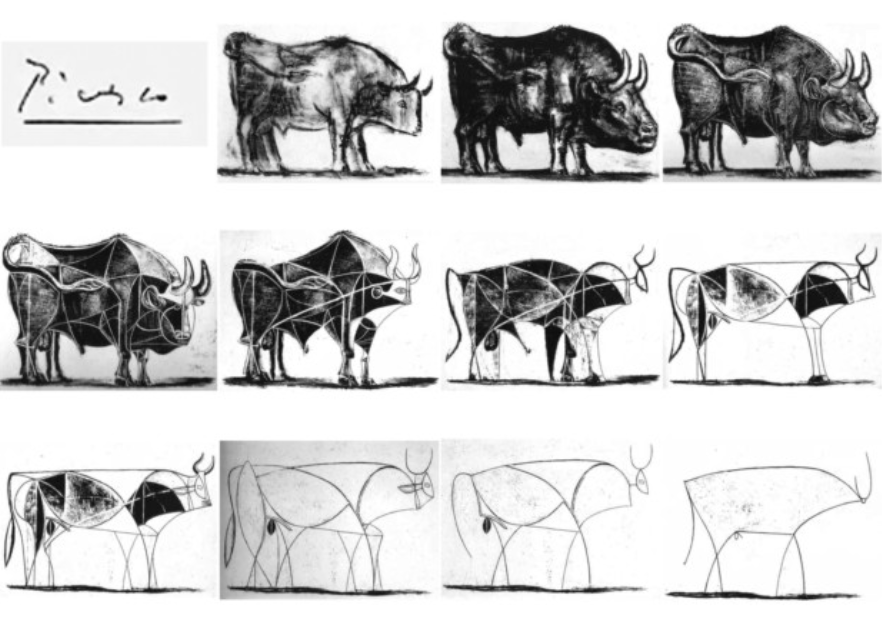
Then we examine Picasso’s Bull series. As Picasso redraws the bull again and again, details disappear. The shading fades. The muscles simplify. Eventually, only essential lines remain, yet we still recognize the bull. That progression makes abstraction visible.
Figure 2. Picasso’s Bull series, a visual example of abstraction as the gradual removal of nonessential detail
From there, students shift to Quick, Draw!, where a computer attempts to recognize their sketches. The question becomes: What features does the computer need in order to recognize the object?
To go beyond simply playing the game, I would extend the lesson by challenging students to try to “stump” the AI. Can they remove just enough detail to confuse the computer while still making the object recognizable to a human? That angle introduces a deeper layer of thinking about how humans and machines interpret patterns differently.
Students already use abstraction constantly. They underline key information in word problems. They summarize by selecting the most important events. They explain the rules of a game without listing every possible scenario. Naming abstraction when it happens helps students recognize that this is not a new skill, but one they already use.
Computation strengthens that skill. Coding requires identifying only the essential steps for a program to run. Extra instructions create confusion. Missing instructions cause failure. Abstraction in computer science mirrors abstraction in reading, writing, math, and even art.
This lesson brings all of that together. Abstraction is not about making something smaller. It is about making it clearer. And helping students see what matters is a skill that extends far beyond computer science.
 Alexis Flanders