For my final creation in unit 4, I created a mini lesson on multiplicative thinking focused on patterns and generalization.
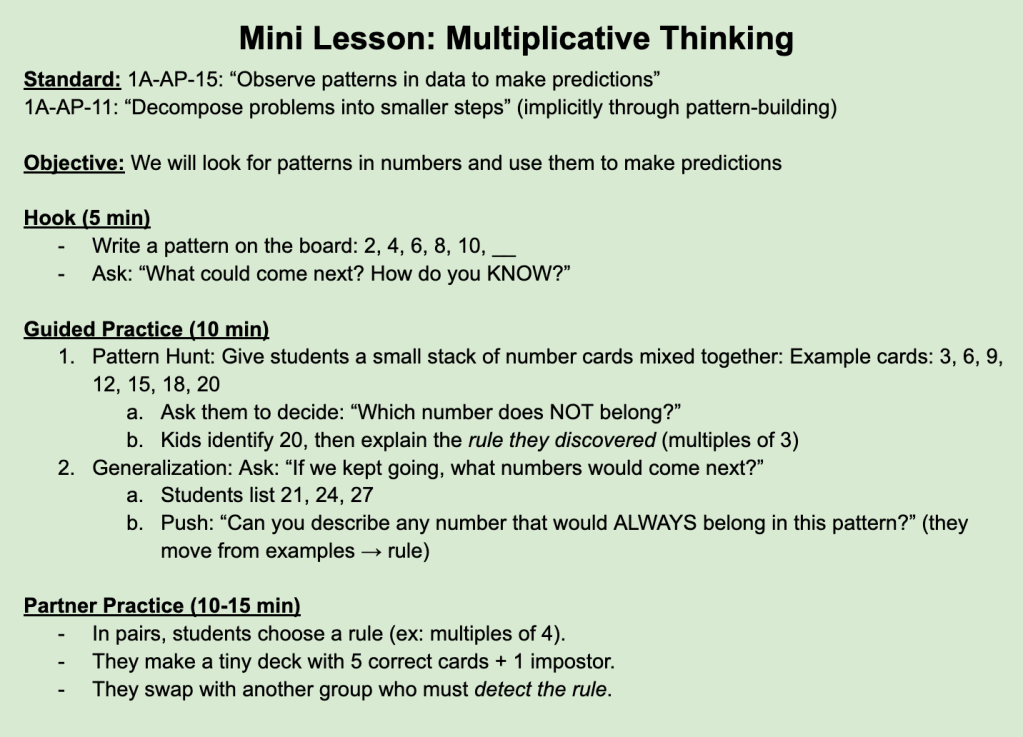
The objective is simple: students observe patterns in numbers and use them to make predictions. We begin with a familiar sequence, 2, 4, 6, 8, 10, __, and ask not just what comes next, but how they know. That shift from answer to explanation is where computational thinking lives.
As the lesson goes on, students identify an “impostor” number in a mixed set and then move toward generalizing the rule. Instead of listing examples, they articulate the pattern itself. That movement from specific cases to a general rule is valuable.
What stood out to me while designing this lesson is how closely creativity and learning are connected. Creativity does not always mean inventing something new. Sometimes it comes from seeing a new pattern in the same information. When students begin asking, “What is always true here?” they are engaging in structured discovery.
I was also personally fascinated by binary during this unit! Exploring how the same sequence of 0s and 1s can represent numbers, letters, or instructions felt like unlocking another layer of meaning. It reinforced how patterns are everywhere, even when they are hidden beneath abstraction.
This lesson connects directly to my classroom practice. Skip counting and identifying multiples are foundational third-grade skills. Asking students to describe multiple characteristics of a pattern pushes their thinking beyond memorization. It helps them move toward reasoning.
Patterns are not just about what comes next. They are about why. That “why” is where both computational thinking and creativity begin.
 Alexis Flanders
Leave a comment