Over the past two weeks, my thinking about algebra has started to shift in an unexpected way. I came in ready to focus on content and tools. I am leaving thinking about identity.
Algebra, even at the 3rd grade level, asks students to make sense of relationships, patterns, and unknowns. This work builds their mathematical foundation. For my students, this shows up in how they make sense of equal groups, unknown quantities, and the relationships between operations. However, I am beginning to wonder if access to that kind of thinking is truly equal in our classrooms.
In a recent activity, I asked my students to draw what they think a mathematician looks like. The results were not surprising, but they were unsettling. Many of the drawings reflected narrow ideas of who belongs in math.
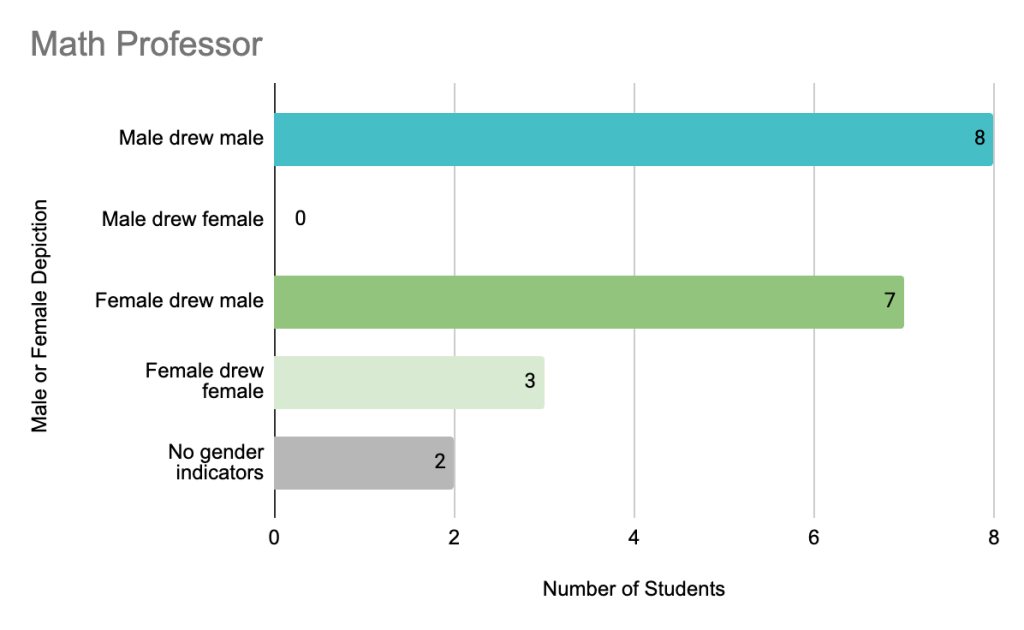
This directly connects to research by Kim et al. (2025), which found that students’ perceptions of mathematicians are influenced by gender. Seeing these patterns in my own classroom made the research feel immediate and real.
I find myself asking: What messages are my students already carrying about who is “good” at math? And, perhaps more importantly, what am I doing, intentionally or unintentionally, to reinforce or disrupt those ideas?
This is where my Knowledge of Content and Students (KCS; Hill & Ball, 2009) has deepened. Algebra is not just about solving for an unknown. It is about who feels comfortable engaging with the unknown in the first place. If a student already believes math is “not for them,” then even the most engaging lesson or technology will have limited impact.
The readings on identity ignited this thinking and pushed me further. Kimberlé Crenshaw (2016) discusses how overlapping identities shape experiences, and Cosby (2020) highlights how controlling images can influence how Black girls experience mathematics spaces. This aligns with broader understandings of identity as shaped by social experiences and context (Psychology Today, n.d.).
I cannot ignore the fact that identity is a part of math learning. I have come to realize it is embedded within it.
Now I begin to question my use of technology as well. What role does technology play in shaping participation and identity in algebra learning?
Tools like Flocabulary or Polypad can make ideas more accessible and engaging.
They can provide multiple entry points and reduce barriers to participation. However, it is important to acknowledge that they also come with constraints. Technology cannot replace meaningful discourse, and it cannot fully account for the social dynamics that shape who speaks, who hesitates, and who feels seen in our classroom. If anything, technology can sometimes hide who is participating and who is not if we are not paying close attention.
Ultimately, the goal is not to find the “best” technology, but to use technology intentionally within a classroom culture that values all ways of participating.
This brings me back to my own practice. If I want students, especially those who are historically marginalized, to see themselves in mathematics, I have to be deliberate. I have to create spaces where their ideas are heard, where mistakes are normalized, and where multiple ways of thinking are valued. I have to pay attention not just to who is correct, but to who is contributing, who is trying, and who is quietly disengaging.
Algebra is often introduced as a shift in thinking. For me, it has become a shift in perspective.
It is not just about solving for x.
It is about who believes they are allowed to try.
References
Cosby, M. D. (2020). No Black girls allowed: A poststructural analysis of controlling images in Black girls’ undergraduate mathematics learning experiences (Doctoral dissertation, Michigan State University). ProQuest Dissertations & Theses Global.
Crenshaw, K. (2016). The urgency of intersectionality [Video]. TED Conferences. https://www.ted.com/talks/kimberle_crenshaw_the_urgency_of_intersectionality
Hill, H. C., & Ball, D. L. (2009). The curious—and crucial—case of mathematical knowledge for teaching. In F. K. Lester Jr. (Ed.), Second handbook of research on mathematics teaching and learning (pp. 111–155). Information Age Publishing.
Kim, J., Hornburg, C. B., Grose, G. E., Levinson, T. G., & Fazio, L. K. (2025). Picturing mathematicians: Examining how gender and math anxiety relate to students’ representations of mathematicians in late elementary and middle school. Journal of Experimental Child Psychology, 258, Article 106290. https://doi.org/10.1016/j.jecp.2025.106290Psychology Today. (n.d.). Identity. https://www.psychologytoday.com/us/basics/identity
 Alexis Flanders
Leave a comment