If a child walked up and asked, “What is an angle?” how would I respond?
Two rays that share an endpoint.
A measure of rotation.
A fraction of a full turn.
I know those answers. But do I understand what it means to teach that idea to someone?
Geometry has always felt like the “last” unit. When curriculum pacing slips, geometry quietly absorbs the loss. I find myself wondering: what message does that send? If number and operations get months of attention and geometry gets weeks (if we are lucky), are we unintentionally signaling that spatial reasoning is secondary?
And yet, when I look at my classroom, geometry is anything but secondary.
In past years, my students hunted for a “lost angle” in a bucket of Orbeez after solving for missing measures. Each task card showed a set of related angles with one missing value, and once students calculated that missing measure, they searched the Orbeez bin for the matching angle piece to complete their card.
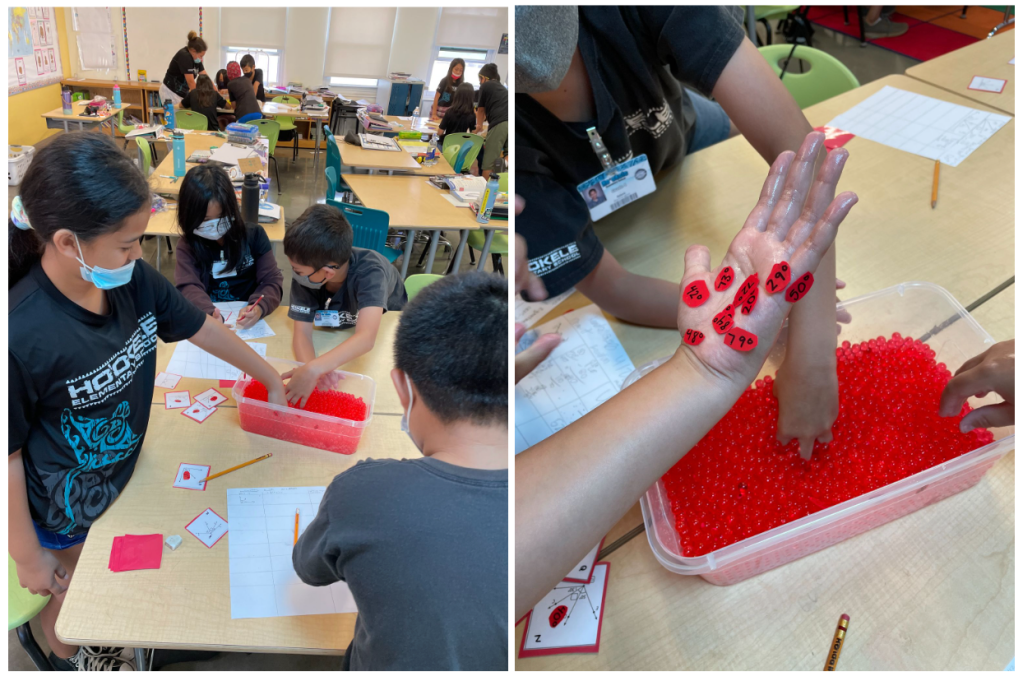
They went “fishing” for acute, obtuse, and right angles to rebuild full circles in a game we called Caught Acute Fish. The room was loud. They were moving. They were arguing about 90 degrees.
It was magnetic.
At the time, I celebrated the engagement. Now, after reading about process standards and participation mathematics (Martínez Hinestroza, 2019), I am asking harder questions.
- Were students merely participating in activity, or participating in reasoning?
- Did the play invite sense making, or did it simply disguise procedures?
- Was I creating space for multiple strategies, or funneling them toward one “correct” approach?
This reflection has sharpened my Knowledge of Content and Students (KCS; Hill & Ball, 2009). I know many of my students are hesitant to speak unless they are certain they are correct. I was that student. Participation, to me, once meant public correctness. Now I interpret participation differently. A student quietly trying a peer’s strategy is participating. A student gesturing agreement is participating. A student revising their thinking mid-game is participating.
Geometry, especially, demands that we broaden our definition of participation. Spatial reasoning is not equally distributed. Some students instantly visualize rotations and symmetry. Other students need physical movement, drawing, and talk. That is not ability, it is experience. The kinds of spatial play historically encouraged for boys often differ from those encouraged for girls. If construction toys and spatial tasks are culturally coded as “for boys,” and relational or doll-based play is undervalued mathematically, then we are not just teaching geometry. We are navigating identity.
That realization has unsettled me in a productive way.
What if expanding participation structures in geometry is also a way to expand who feels like they belong in mathematics?
When I play “Geometry Simon Says” with various lines and angles, I am not just rehearsing vocabulary. I am building embodied understanding.
When I label strategies in Number Talks and refer back to them later, I am not just reviewing content. I am preserving student thinking in the room.
Kilpatrick et al. (2001) remind us that mathematical proficiency includes conceptual understanding, strategic competence, adaptive reasoning, and productive disposition. Geometry offers valuable context for all four. But only if we resist the urge to treat it as a checklist at the end of the year.
So now I wonder:
- What would it look like if geometry were treated as foundational rather than supplemental?
- What would shift if participation were measured by reasoning rather than volume?
- How might playful, rigorous geometry experiences disrupt quiet narratives about who is “naturally good” at math?
Perhaps the right angle is not just 90 degrees.
Perhaps it is the perspective from which we choose to teach.
 Alexis Flanders
Leave a comment