In a world where we seem to have all the answers at our fingertips, are we unintentionally failing to understand? Technology has brought about numerous opportunities and pathways to obtain answers to our questions. However, should simply getting an answer be the end goal or should there be an end goal at all? Through the introduction, and first two chapters of W. Berger’s “A More Beautiful Question,” he discusses our innate nature to question and problem solve, and how it seems to almost fade as we age. He questions how we can teach questioning and inspire this need for change. Essentially, can we rekindle our questioning spark (Berger, 2014)?
Children spend a significant amount of time questioning things to simply gain understanding. In fact, four years old is our questioning peak (Berger, 2014). So why do we become more complacent over time? Are we fulfilled with the answers we have? Are we losing the ability to ponder deeply? Or perhaps we are underestimating our own ability to answer our own questions. Questioning enables innovation, problem solving, and brings about change (Berger, 2014). We are capable of bringing about such change if we know how to question.
Berger covers three major steps to simplify questioning: Why → What if → How (Berger, 2014). Stopping at why is stunting our growth in its tracks. “If you never do anything about a problem you’re not questioning, you’re complaining” (Berger, 2014). For some this could be because there are experts around whom seem to have (or think they have) all the answers. Berger argues that “what ifs” are not always welcomed in “what is” spaces. This calls into question our education system – are teachers the experts that have all the answers so students are failing to ask? If so, how can we ensure we are teaching students to ask beautiful questions? Beautiful questions are ambitious, actionable questions that can begin to shift the way we think and perceive something and can be used as a catalyst to bring about change (Berger, 2014). He states that questioning + action = innovation, and inversely questioning – action = philosophy. As an educator, my goal is to push my students towards innovation, in turn teaching them to question is the first step. This connects closely to my favorite third-grade lesson: “It is okay to make mistakes, but it is not okay to not try.” This lesson encourages students to take academic risks and view mistakes as learning opportunities, which reflects what Berger describes as the importance of “failing forward” in the questioning process.
I was asked to complete a quickfire exercise that encapsulates this idea. Having us question starting with just the “why.” Set a timer for five minutes, and write all the questions (related to your practice) that come to mind. Being asked to question in that way was a bit intimidating and difficult to not over think, however, below are the questions I was able to generate.
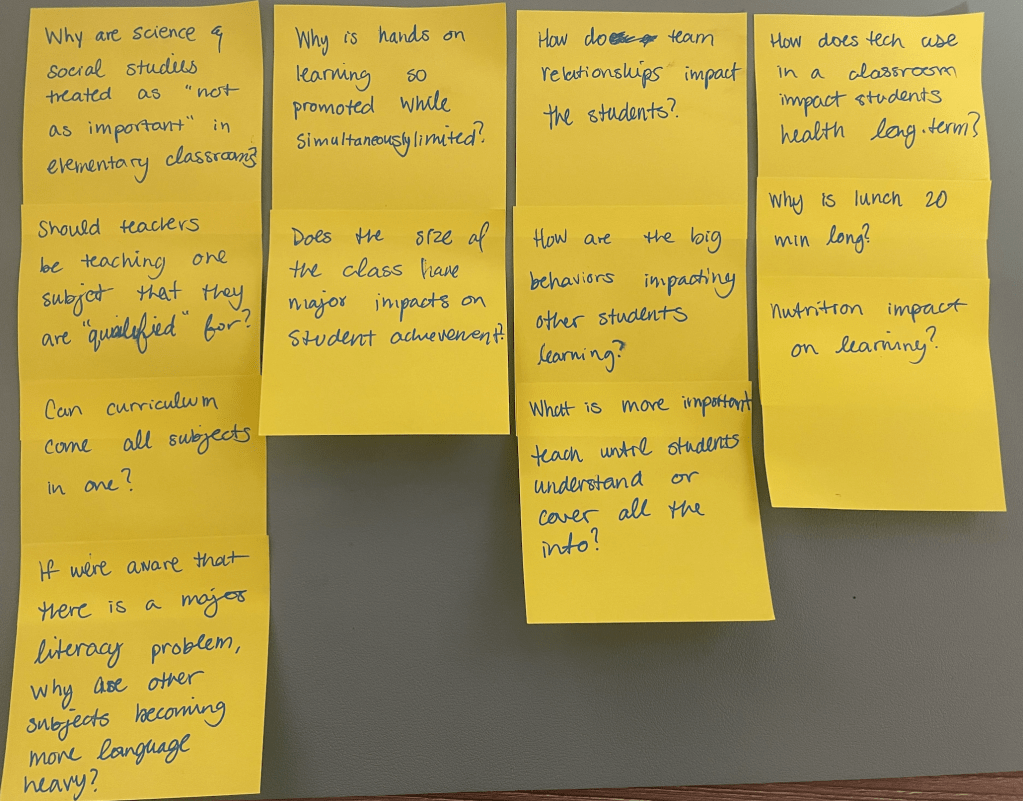
Some questions related to others while some came out of left field. I also found it difficult to sustain the questioning process mentally over time. As soon as I had a question written I wanted to start thinking about the next step, searching for answers, the what if.
After the why comes the what if. Moving from asking to action. This is where imagination takes over – where the seeds of innovation are planted (Berger, 2014). What if is finding the space to connect interesting ideas in unusual ways involving both connections and questions. Berger coined this as “connective inquiry.” He then states that a questioner’s ability to conform to their ideas and make them real is what sets them apart and leads into the final critical stage of questioning: the how. This final stage is where we work to figure out “how do I actually get this done?” It is driven by practical questions to lead to an answer. However, each answer brings a fresh wave of questions, which lead to mine: should there be an end goal? If we want to impart on our students the ability to ask beautiful questions I believe the first step is to be a questioner ourselves. As we continue to read, I look forward to learning how Berger suggests we do that. This reinforces my belief that cultivating a culture of questioning in the classroom must be intentional, modeled, and continuously supported.
References
Berger, W. (2014). A more beautiful question: The power of inquiry to spark breakthrough ideas. Bloomsbury.
 Alexis Flanders
Leave a comment