Learning as a Living Tree
Learning is a living process that grows through connection and purpose. It begins in community, is sparked by curiosity, strengthened through exploration, deepened through reflection, and sustained by the people, tools, and world in which we live. Learning takes hold in what we already know and who we are, then stretches beyond those roots as we engage with others and move toward meaningful goals. It is not passive. Learning is active, living, and continuously growing.
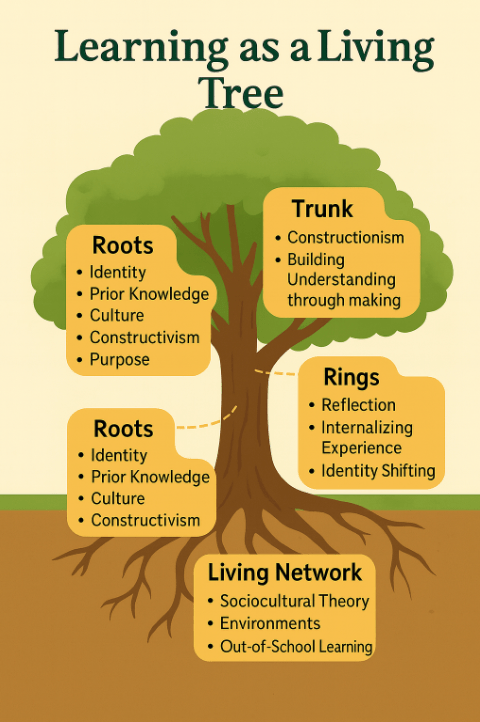
I understand learning as a developmental process rooted in meaningful experience and nurtured through relationships with others. Our learning is like a tree, grounded in prior knowledge and identity, shaped by the environment and those around us, and strengthened through purposeful engagement. A tree grows from a seed, not in isolation. Its growth depends on the soil that surrounds it, the climate, the supports or challenges it faces, and the network of life that interacts with it. In the same way, learning develops through active participation in the social, cultural, and intellectual worlds that surround us (Vygotsky, 1979; Lave & Wenger, 1991). Knowledge is not something that can simply be spoken into a learner. It is constructed, tested, revised, and extended with others through lived experience (Ackerman, 2001).
Roots
The roots of a tree firmly ground it and supply the nutrients that allow it to grow. In learning, roots represent prior knowledge, our own personal identities, and the motivations that give learning meaning. New understanding takes hold by connecting to what a learner already knows and values. Without our roots, information may be memorized temporarily, but it rarely becomes true, valuable understanding.
Learning deepens when it has purpose. Purpose fuels the will to persist and improve. The things I have learned most fully in my life have been those tied to meaningful goals. When I trained for a half marathon, the learning involved far more than accumulating miles. It required coordinating nutrition, pacing, strength work, and reflecting on what was and was not working for my body. That process drew from what I already knew about persistence in athletic training, but it also required new knowledge, trial and error, and constant reflection about how to adjust and be better. The learning was anchored in who I was, the goals I was working towards, and my desire to grow. Like roots taking hold in soil, purpose gave that learning a reason to deepen.
A tree cannot grow without the right environment. The soil quality, climate conditions, and surrounding organisms influence how well the roots absorb nutrients and whether growth is supported or restricted. Similarly, learning is inseparable from the social and cultural environments in which it takes place (Vygotsky, 1979). The community, language, tools, values, and social norms of a learning space shape what is available to learn, how learning is expressed, and what forms of knowledge are recognized.
The sociocultural perspective views learning as a process of becoming through participation in cultural practices (Lave & Wenger, 1991). People learn by engaging with those around them, using the tools and symbols of their community, and gradually moving from peripheral observation to more active participation. Within these shared practices, learners actively construct understanding by connecting new experiences to what they already know, reflecting a constructivist view of learning as developing meaning rather than passive absorption (Ackerman, 2001). What a person knows and who they are becoming cannot be separated from the environments in which they learn. Constructionism further emphasizes that this process is strengthened when learners create and explore ideas through hands-on activity, using the tools and practices of their community to make thinking visible (Harel & Papert, 1991). Identity and learning develop together.
This anchoring of new understanding to what someone already knows further reflects constructivist and constructionist perspectives. Together, these theories emphasize that learning grows through active meaning making and purposeful creation rather than passive reception (Ackerman, 2001; Harel & Papert, 1991).
Not all learners experience alignment between their identities and the environments where they learn. When the soil does not reflect or value a learner’s cultural background, language, or ways of knowing, the learner is not nourished in the same way. Recognizing the role of culture in learning does not prescribe a particular teaching action, but it acknowledges that the environment deeply matters. The soil that surrounds a learner supports or limits the root’s ability to take hold and grow.
A young tree growing on the edge of a clearing leans toward the sunlight. It adapts to the conditions it was given. The trees deeper in the forest grow straighter, supported by shade, shelter, and rich soil. Each is learning how to grow, but not under the same conditions.
Trunk
The trunk of a tree represents the development of structure, strength, and overall coherence. In learning, this development occurs through doing something with knowledge. Constructionism emphasizes that learning becomes most powerful when people actively create, experiment, and make meaning with real tools and materials (Ackerman, 2001). Through making, ideas take form, becoming testable and adaptable. Understanding moves from abstract to tangible.
Harel and Papert (1991) expand on this by recognizing that learning grows through the interplay of constructing ideas in the mind and constructing something in the world, allowing each to strengthen the other.
Constructionist learning is evident when learners are able to design, build, write, perform, or create something that expresses and tests their thinking. The process of making becomes the process of understanding.
This perspective reflects my own experiences. Whether learning to use my bow with my family or preparing for a race, learning developed through practice with feedback, making adjustments, and applying what I was discovering. It was not a lecture or a list of steps that built my understanding. It was the act of doing.
Branches
Branches stretch a tree upward and outward, reaching for the light and for new possibilities. In learning, branches represent the ways we grow through observation, imitation, and social interaction. Much of what we come to know is influenced by the people we watch, observe, and interact with.
Social learning highlights that understanding often begins by noticing how others think or act, holding on to those ideas, trying them out for ourselves, and refining them over time (Bandura, 1971; Cherry, 2025).
Throughout my life, I have learned a great deal by observing the practices of others in both my personal and professional worlds. When I became a teacher, I watched colleagues greet students, the ways they structured their days, and how they communicated with families. I noticed what felt authentic to me and what did not. Listening to professors talk through their thinking and share their own classroom experiences allowed me to picture new possibilities for my own development. Even social media has become a space for that, influencing my learning. Observing different creators, educators, coaches, and all of these digital experts who provide ideas and strategies gives me things I can try, reflect on, and reshape into something that fits who I am.
Growing through observation is not always positive, though. The same visibility that inspires growth can also influence habits, beliefs, or behaviors that limit us. I have learned ineffective practices simply because they were common or praised. There have been moments when I caught myself speaking in a way that did not feel like my own voice, only to realize I had absorbed the language of others without questioning its impact. I see students experience the same thing. You become a product of your environment, and that’s not always positive. Observation is powerful, but not always beneficial. It takes awareness to notice what we are internalizing and whether it supports the kind of learner or person we are becoming.
A moment that stands out is when I first began sharing classroom ideas with coworkers. Early in my career, I often mirrored different management styles because that was what I had seen modeled as successful. Over time, I realized the classroom environment I wanted relied on warmth, relationships, and shared ownership. I could not simply imitate what I had observed. I had to notice, evaluate, adapt, and then integrate the ideas that aligned with who I was and who I hoped to become. That is where learning expanded. Not just a copy and paste, but reflection and application.
Observation creates opportunities, but reflection transforms them. Branches grow toward the sun that feels most sustaining. In the same way, learners expand in directions they find meaningful through support and inspiration.
Rings
The rings within a tree tell the story of its life. Each ring marks a season of growth shaped by the conditions of that time. Some years produce wide rings, full of nourishment and expansion. Others are thinner and harder earned. Reflection works in a similar way. It helps us notice what we’ve learned and how it’s shaped us, revealing how our learning has grown over time.
Some of the most important learning in my life has come from looking back. Reflection gives meaning to experience and reveals how one season of learning prepares us for the next. The process of training for my half marathon and learning to hunt did not feel profound in single moments. The understanding came later through looking back at the choices I had made, the successes I experienced, the discomfort I pushed through, and the growth that followed. Reflection helped turn isolated experiences into a connected story of who I was becoming.
In the classroom, I often observed this same process. A student who struggled early in the year would look back months later and suddenly recognize the progress they had made. They could see how their thinking expanded and how they were able to handle challenges differently. Their practice shaped confidence. The moment of noticing became another ring of growth, marking not only what they had learned, but how learning had changed them.
These moments of realization also reflect sociocultural and constructivist perspectives. reflection allows learners to internalize shared experiences and recognize their understanding, turning social participation into personal meaning (Vygotsky, 1979). Constructivist views similarly recognize reflection as the process through which new experiences reshape existing knowledge frameworks (Ackerman, 2001). In this way, reflection does not sit outside the learning process. It is one of the ways new rings form.
Reflection is what helps learning settle into the trunk of who we are. Without it, experiences remain scattered like fallen leaves. With it, they become the rings, strengthening our sense of self and expanding our understanding of the world.
The Living Network
A single tree is never truly alone. Even trees that appear separate above ground are often connected through shared soil and nutrients in underground networks. Learning also exists within systems that extend beyond human interactions. The natural world, animals, technology, and environments all influence how we learn and who we become.
Some of my most memorable learning has come from interacting with the natural world. Practicing archery outdoors, observing animal behavior, and learning how to track movements in the woods required attention to the environment, the wind, and the sounds. The learning came from direct interaction, not from another person explaining it. Instead, learning developed through repeated observation paired with feedback from the environment and adjustment over time. The woods themselves taught me to be still, patient, and aware. This process embodies social learning theory, which emphasizes learning through observation and interaction with your environment rather than solely through direct instruction (Bandura, 1977). Learning in this sense was relational, but the relationship extended beyond human interaction.
Digital tools also expand learning. Technology allows us to join communities beyond our physical spaces, explore interests, and gain access to knowledge that would otherwise be out of reach. Learners can develop understanding through interaction with tools that extend what they can see and do. Through digital spaces, learners also engage in vicarious learning by observing others and modeling strategies while adapting behaviors based on shared experiences.
Research on out-of-school learning illustrates the same idea. Learning happens in museums, community centers, outdoors, in homes, and in digital environments where people get to explore interests, engage in cultural practices, and make meaning with others (Vadeboncoeur, 2006). These spaces broaden the network that supports growth by offering experiential learning that is flexible and self-directed while being connected to the real world. This supports social learning by allowing learners to observe, experiment, and reflect within authentic environments.
These influences also echo social learning theory, where learning develops through observing, interacting with, and responding to both human and non-human elements within the environment through reciprocal relationships between behavior, personal factors, and environmental conditions (Bandura, 1977; 1986). Whether watching the behavior of animals, responding to environmental cues, or engaging with digital communities, learners draw from the networks around them to construct understanding. Learning remains relational even when the relationship extends beyond direct human contact.
Closing
Learning is a living process, like a tree. It is rooted in who we are and where we come from. It grows through experiences, connections, and our ability to reflect and reach outward into new possibilities while drawing strength from what has come before. Over time, learning becomes part of our identity, shaping how we see the world and how we move through it.
Taken together, these ideas show learning as an interconnected system rather than a single process. The Roots reflect constructivist and constructionist perspectives, grounding learning and prior knowledge, identity, and purposeful engagement (Ackerman, 2001; Harel and Papert, 1991). The trunk represents the growth that develops through active making and doing. The branches reflect social learning, expanding understanding through observation and modeling while participating with others (Bandura, 1971). The Rings highlight reflection as the force that deepens meaning and connects experiences over time (Vygotsky, 1979). Even the living network surrounding the tree illustrates how environments and communities continually influence growth. Together, these perspectives form a theory of learning that is dynamic and grounded in experience.
These ideas align with research on out of school learning which captures the idea that a learner’s growth spans across settings, cultures, relationships, skill levels, and life experiences rather than being confined to formal environments (Resnick, 1987).
The most meaningful learning is not quick nor passive. It is lived, appreciated, shared, and carried forward. It leaves rings within us, marking who we were, who we are, and who we are becoming.
References
Ackerman, E. (2001). Piaget’s constructivism, Papert’s constructionism: What’s the difference. Future of Learning Group Publication, 5(3), 1–11.
Bandura, A. (1971). Social learning theory (Vol. 1). General Learning Press.
Cherry, K. (2025, March). Albert Bandura’s biography (1925–2021). Verywell Mind.
Harel, I. E., & Papert, S. E. (1991). Situating constructionism. In I. E. Harel & S. E. Papert (Eds.), Constructionism (pp. 1–11). Ablex Publishing.
Lave, J., & Wenger, E. (1991). Situated learning: Legitimate peripheral participation. Cambridge University Press.
Resnick, L. B. (1987). Learning in school and out. Educational Researcher, 16(9), 13–20.
Vadeboncoeur, J. A. (2006). Engaging young people: Learning in informal contexts. Research in Education, 30(1), 239–278.Vygotsky, L. S. (1979). Consciousness as a problem in the psychology of behavior. Russian Social Science Review, 20(4), 47–79.
 Alexis Flanders
Leave a comment