Automation felt straightforward at first. Systems follow rules. They remove repetitive work. They free up time and mental energy. Simple enough…or so I thought.
For my automation creation, I created an unplugged classroom activity where students act as robots. Partners give step-by-step instructions to complete a task. If the directions are unclear, the “robot” fails. If the steps are precise, the task works.
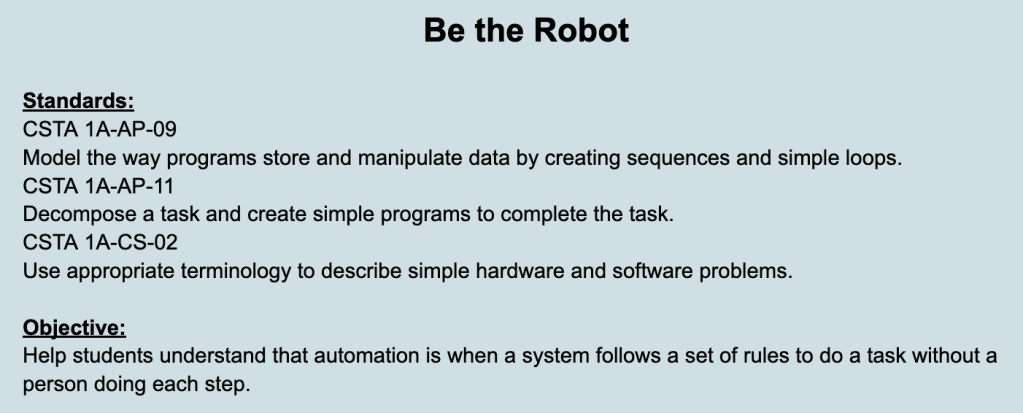
It connected beautifully to sequencing and debugging. Students would:
- Break a task into small pieces.
- Test their “program.”
- Revise when something went wrong.
It felt natural. It mirrors how I already teach clear routines and procedures in my classroom.
And then I received feedback…
My professor pointed out that while the activity clearly connected to algorithms, it did not yet make the need for automation obvious enough. It showed how to follow instructions, but not necessarily why we automate in the first place.
That distinction mattered. Algorithms are about steps, while automation is about reducing repeated thinking. That subtle difference pushed my thinking further.
When I revisited my brainstormed examples of automation in my students’ lives, it became clearer:
- Logging in with QR codes instead of typing credentials
- Math programs adjusting difficulty automatically
- Google Classroom surfacing commonly used links
- Spell check correcting without teacher intervention
- Classroom timers running routines
All of these systems remove the need to re-decide something over and over again. My unplugged activity captured the structure of instructions. What it almost captured was the relief automation brings when something becomes repeatable.
That feedback didn’t invalidate my lesson. It helped refine my understanding. Automation is not just following steps. It is designing systems so the steps no longer require new effort each time.
As an elementary teacher, I see this constantly. Routines become automatic. Transitions become automatic (hopefully). Classroom systems become automatic. And when they do, students have more energy to think deeply about content instead of logistics.
That realization felt bigger than the activity itself.
Automation is not flashy. It is the sneaky invisible efficiency.
And understanding that difference sharpened my thinking far more than simply completing the assignment ever could.
 Alexis Flanders
Leave a comment