Unit 6 shifted my focus to automation, and it immediately felt relevant to students’ everyday lives.
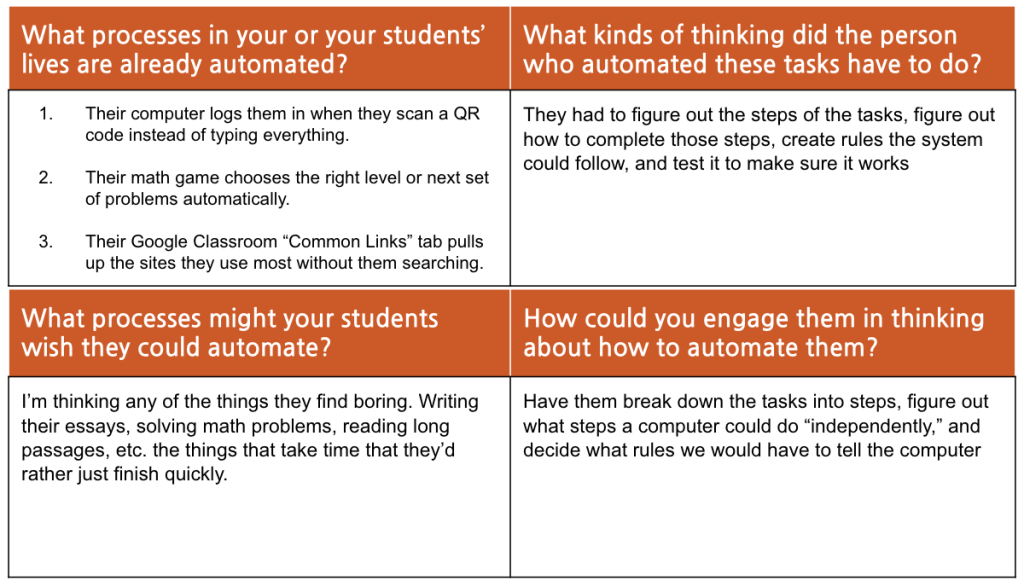
In my first activity, I brainstormed examples of automation my students already experience. Their computers log them in automatically when they scan a QR code. Math platforms adjust difficulty levels without a teacher intervening. Google Classroom surfaces commonly used links so students do not have to search for them.
When we pause to name it, automation is everywhere.
What struck me most was the thinking required behind those systems. Someone had to break down the task into steps, determine rules the system could follow, anticipate edge cases, and test the process. Automation is not about replacing thinking. It is about doing the work up front.
When I asked myself what students might wish they could automate, the answers were predictable: writing essays, solving long math problems, and reading extended passages. The “boring” tasks that are time consuming.
That opens a fun classroom conversation. If you wanted a computer to write your essay for you, what steps would it need? What rules would you have to define? What decisions would it struggle to make? Breaking down those processes reveals the complexity students (and teachers) often underestimate.
To bring automation into math instruction, I created a simulation lesson using the Chocomatic simulator fromExploreLearning’s Gizmos platform. Gizmos provides structured simulations with built-in lesson materials, but I designed my own activity plan around this tool to align specifically with my focus on arrays, decomposition, and the distributive property.
In the lesson, students build an array in the simulator, then decompose it into two smaller arrays and record the corresponding equations. They repeat the process in a second way and compare what changed and what stayed the same.
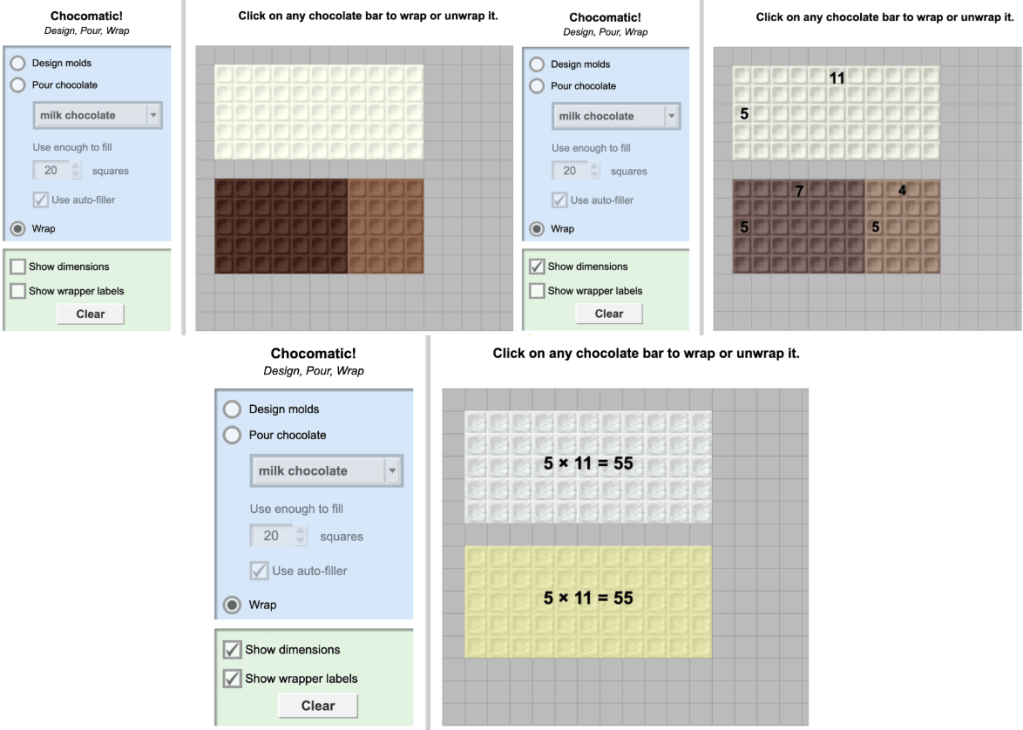
This activity highlights automation in a subtle way. The simulator removes the manual drawing process so students can focus on structure. The repeated steps of build, decompose, record, and compare, mirror algorithmic thinking. Students are basically creating a repeatable procedure for breaking apart multiplication facts.
The partner challenge adds another layer. When students show only the decomposed arrays and ask a partner to reconstruct the original, they are reasoning about the underlying structure rather than just the surface representation.
Automation in this context is not about speed but about clarity. It allows students to see patterns and relationships without getting lost in mechanics. The more I think about it, the more I realize that automation is really about designing systems that handle repetition so humans can focus on reasoning.
And that is something worth making visible to students.
 Alexis Flanders
Leave a comment